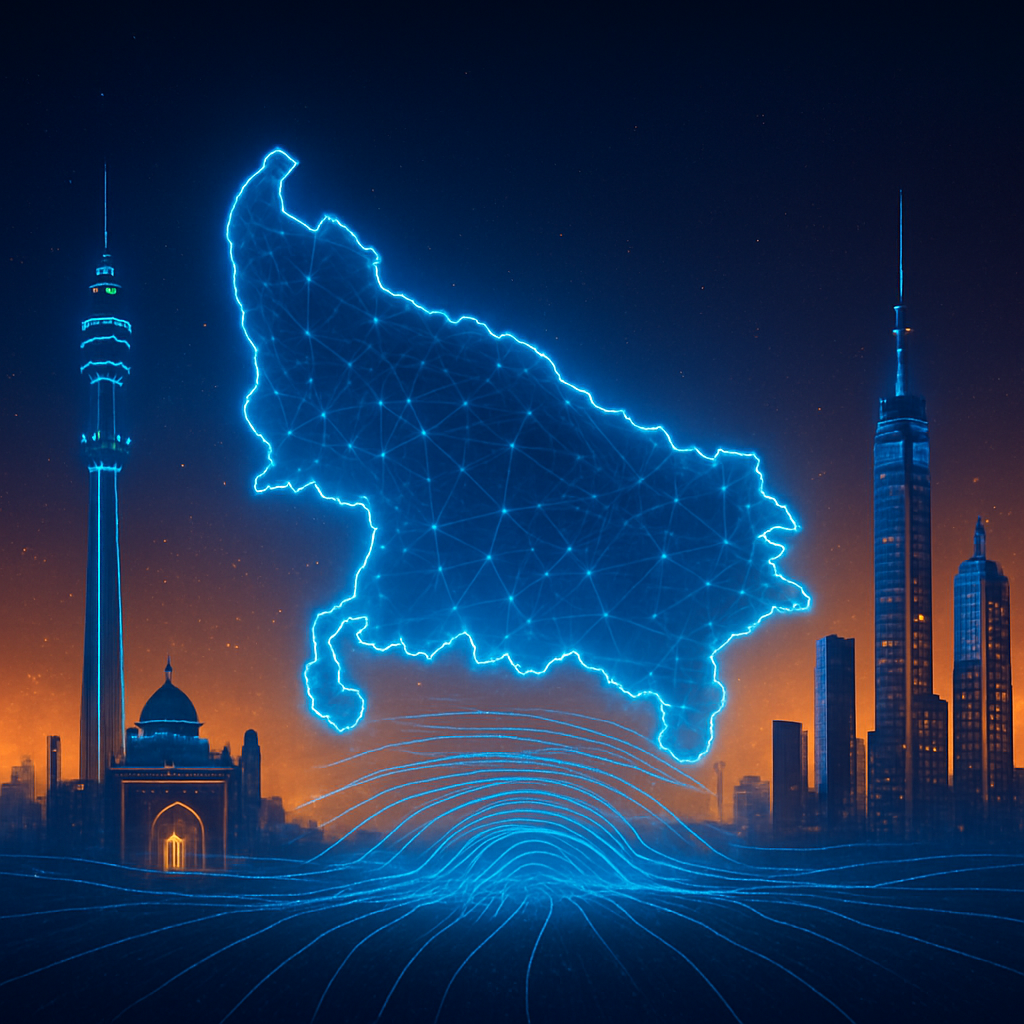
Uttar Pradesh and the Digital Revolution: How UP Is Becoming India's Next Software Powerhouse
Uttar Pradesh — long seen as a laggard in technology adoption — is undergoing a quiet but profound digital transformation driven by government policy, infrastructure investment, and a new generation of entrepreneurs. Here is what is happening and what it means for businesses of every size.
ElevoraX Research
Strategy & Research
Uttar Pradesh is the most populous state in India — 240 million people, a GDP larger than many countries, and until recently a reputation for lagging behind Maharashtra, Karnataka, and Tamil Nadu in technology adoption. That narrative is changing, rapidly and visibly.
The Government Push: Policy Meets Infrastructure
UP IT Policy 2022 and IT City Projects
The UP government's IT Policy 2022 offered some of the most aggressive incentives for technology companies in India — 100% stamp duty exemption, subsidised land for IT parks, capital subsidy of up to 25% for new IT/ITeS units, and a fast-track single-window clearance process. Lucknow, Noida, Agra, Kanpur, and Varanasi were identified as IT City hubs, with Noida already functioning as a mature IT hub and the others receiving significant infrastructure investment.
ODOP and Digital Commerce for Small Businesses
The One District One Product (ODOP) programme is one of the most innovative government initiatives in India for small business digitalisation. By identifying and promoting a signature product from each of UP's 75 districts — Lucknow chikankari, Varanasi silk, Agra leather goods, Moradabad brassware — the government created a ready-made market structure for e-commerce onboarding.
The ODOP programme has onboarded over 1.2 lakh artisans and small manufacturers onto digital commerce platforms. For software companies, ODOP represents a template for government-backed market creation — a captive audience of small businesses with a demonstrated need for inventory management, payment processing, and logistics software.
Common Service Centres and Last-Mile Digital Access
UP has over 52,000 Common Service Centres (CSCs) — more than any other state. CSCs function as the digital infrastructure for rural India, providing government service access, banking, insurance, and increasingly, digital literacy. For software companies targeting Tier-3 and rural markets, the CSC network is the distribution channel — a ready-built network of locally trusted operators who can onboard businesses onto software products.
What Software Businesses in UP Actually Need
The software needs of a UP business are different from those of a Bangalore startup. The customer base is different, the connectivity is different, the language is different, and the regulatory environment is different. Understanding these differences is the prerequisite for building software that actually gets adopted.
MSMEs: The 90-Million-Business Opportunity
UP has approximately 90 lakh (9 million) registered MSMEs, making it the state with the highest number of small businesses in India. These businesses — textile units in Surat and Kanpur, food processing in Lucknow, furniture in Saharanpur, jewellery in Varanasi — have almost entirely manual operations. GST compliance software was the first crack in this wall. Inventory management, procurement, and payroll software are next.
- GST and income tax compliance software in Hindi with CA-friendly exports
- Inventory and order management for manufacturing MSMEs with WhatsApp order intake
- Payroll and attendance software for factories with daily wage and piece-rate worker support
- Micro-lending and trade finance integrations for working capital management
- Quality management and certification software for export-oriented units
- Multi-location POS systems for UP's large retail sector
Agriculture: The Largest Sector Still Waiting
UP is India's largest sugarcane producer, largest wheat producer, and a top producer of potatoes and vegetables. Yet agricultural software penetration is minimal. Farmer Producer Organisations (FPOs), of which UP has thousands, are natural buyers of procurement management, price discovery, and logistics software — and the government's PM-KISAN digital infrastructure is creating the identity and payment rails to make farmer software viable.
The Role of Noida and the Delhi-NCR Software Ecosystem
Noida is already India's second-largest IT and software services hub after Bengaluru, with over 2,000 IT companies and a rapidly growing startup ecosystem. The GautamBuddh Nagar district — which includes Greater Noida and the Yamuna Expressway Industrial Development Area (YEIDA) — is being developed as a data centre corridor, with approvals already granted to NTT, Hiranandani, and STT GDC for large-scale data centre campuses.
For enterprise software companies, Noida offers access to Fortune 500 IT services clients, a deep talent pool from IIT Kanpur, IIT BHU, IIIT Allahabad, and dozens of engineering colleges, and proximity to the central government's technology procurement in Delhi. The combination of enterprise clients, talent, and government access makes NCR-UP the most strategically important software market in India outside Bengaluru.
Smart City Projects and GovTech Contracts
Lucknow, Varanasi, Kanpur, Agra, Prayagraj, Aligarh, Bareilly, Moradabad, Saharanpur, and Shahjahanpur have all been selected under the Smart Cities Mission. Each city has a Smart City SPV (Special Purpose Vehicle) that procures technology — integrated command and control centres, traffic management, public Wi-Fi, citizen service apps, and urban data platforms.
The cumulative technology spend across UP's Smart Cities projects is estimated at over Rs 8,000 crore over the mission period. This is a direct procurement opportunity for software companies that can navigate government tendering — and a template being replicated at the district level through the Adarsh Gram Panchayat programme.
How Software Will Evolve for UP's Businesses Over the Next Decade
The evolution of business software in UP will follow a familiar pattern compressed into a shorter timeline, because the lessons of the past decade are already available. Phase one — compliance software — is already underway, driven by GST. Phase two — operations software for MSMEs and agriculture — is beginning now. Phase three — AI-augmented software that learns from UP's specific business patterns and delivers contextual recommendations — will arrive faster than anyone expects, because the foundation models are already trained and require only domain-specific fine-tuning.
- 2025-2027: Mass adoption of cloud-based ERP and inventory management across UP's MSME sector
- 2026-2028: AI-powered credit scoring and working capital software for unbanked MSMEs
- 2027-2029: Vertical AI platforms for UP's dominant industries — textiles, food processing, agriculture
- 2028-2030: Fully integrated digital commerce, payments, and logistics ecosystems displacing informal supply chains
- 2030+: Autonomous business management software that handles routine decisions for small business owners
“UP's digital transformation is not a future aspiration — it is happening now. The software companies that build for UP today, in its languages, for its businesses, with its connectivity constraints, will own the largest software market in India by 2030.”
What ElevoraX Is Building for UP's Digital Future
As a company with deep roots in Uttar Pradesh, ElevoraX is uniquely positioned to build software for this transformation. Our products — EduSphere for schools, enterprise integration platforms for manufacturing MSMEs, and AI-powered automation tools for the retail and agriculture sectors — are designed specifically for the UP market context. We understand the Hindi-language requirement, the intermittent connectivity reality, the UPI-first payment culture, and the GST compliance landscape that defines software adoption in this region.
If you represent an MSME, educational institution, agricultural enterprise, or government body in Uttar Pradesh that is evaluating digital solutions, we invite you to book a consultation. The transformation window is open — the question is whether your business will be early or late to it.