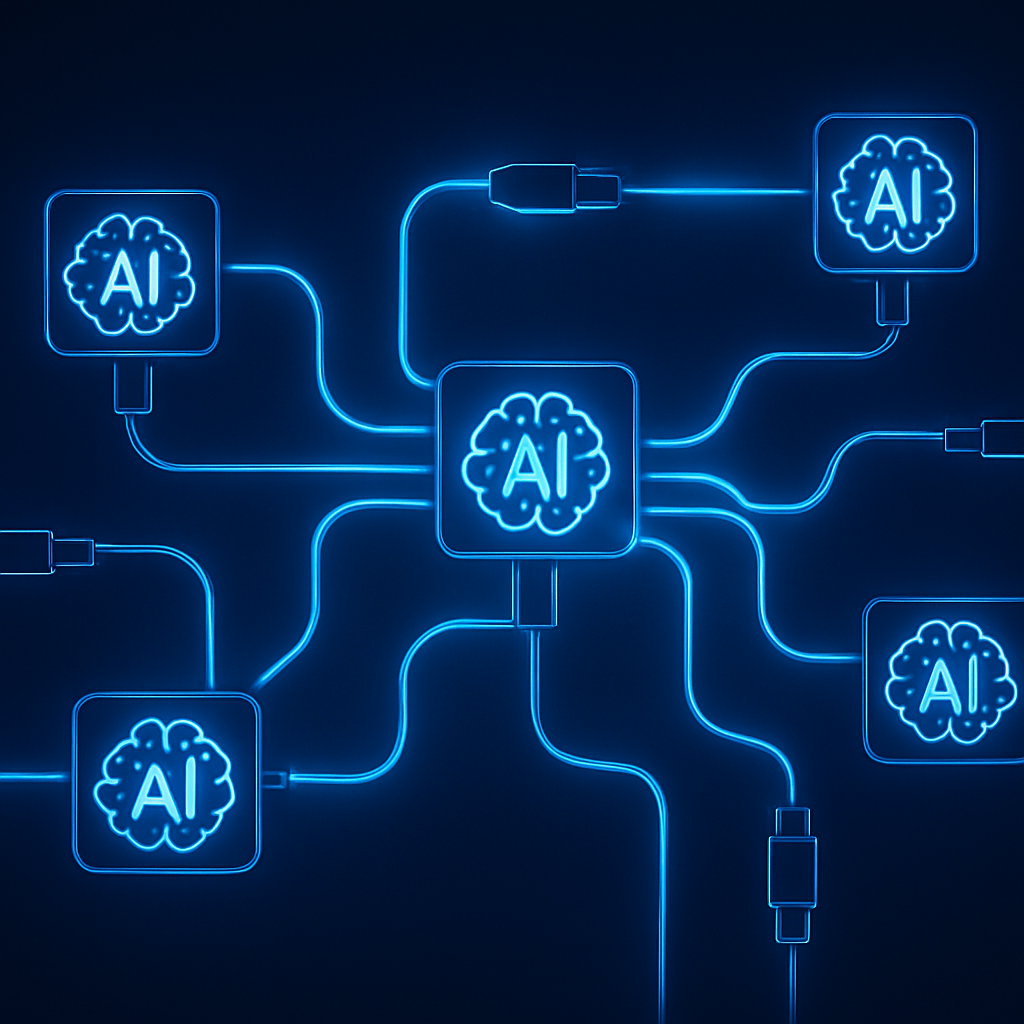
MCP — The Protocol Quietly Rewiring the Software Industry
Model Context Protocol (MCP) is not just a developer convenience. It is the connective tissue that will determine which AI products win and which ones remain isolated demos. Here is why every software team needs to understand it today.
ElevoraX Engineering Team
Core Engineering
In November 2024, Anthropic quietly published a specification called the Model Context Protocol — MCP. Within six months it had been adopted by OpenAI, Google DeepMind, Microsoft Copilot, and hundreds of independent tool developers. It is now the most important protocol in AI that most software engineers have not heard of.
What MCP Actually Is
MCP is an open standard that defines how AI models connect to external data sources and tools. Think of it as USB-C for AI — before USB-C every device needed a proprietary cable, and before MCP every AI integration needed a bespoke connector. MCP standardises the handshake between an LLM and the tools it can use.
At its core, MCP defines three primitives: Resources (data the model can read — files, database rows, API responses), Tools (functions the model can call — run a SQL query, send an email, create a ticket), and Prompts (pre-defined instruction templates exposed by the server to guide model behaviour). Any MCP-compatible client ��� Claude, GPT-4o, Gemini — can connect to any MCP-compatible server and immediately understand what it offers.
Why This Is a Bigger Deal Than It Looks
The End of Bespoke Integrations
Before MCP, connecting an LLM to your CRM meant writing a custom function-calling integration for every model you wanted to support. Claude needed one shape, GPT-4 needed another, Gemini a third. Multiply this across 20 enterprise tools and you have an integration matrix that is impossible to maintain. MCP collapses this to a single server implementation that every compliant model can consume.
Context as a First-Class Citizen
MCP treats context — the information an AI needs to do useful work — as a first-class primitive rather than something you stuff into a prompt. An MCP server tells a connected model exactly what data it has access to, in a machine-readable schema, so the model can plan its retrieval strategy intelligently rather than guessing.
The Composability Breakthrough
Because MCP servers are independent services that expose a standard interface, you can compose them. An AI agent can simultaneously hold an active connection to your GitHub MCP server, your Jira MCP server, your Postgres MCP server, and your Slack MCP server — and plan a multi-step workflow that reads code, creates a ticket, queries the database, and sends a notification, all in a single reasoning loop.
MCP in Production: What It Enables
- IDE-native AI assistants that have real-time access to your entire codebase, documentation, and CI/CD state
- Customer support agents that can actually read your CRM, knowledge base, and order management system simultaneously
- Finance workflows where an AI model can query your ERP, cross-reference market data, and draft board reports without any human context-passing
- DevOps co-pilots that hold live connections to your observability stack, Kubernetes cluster, and incident management system
- Sales intelligence tools that synthesise CRM history, LinkedIn data, and internal deal notes in a single model context window
The Security and Trust Model
MCP's permission model is explicit and minimal. An MCP server declares exactly which capabilities it exposes, and the client (the model host) controls which servers a given model instance can connect to. This makes it possible to give a customer-facing AI agent read access to your knowledge base without also giving it write access to your database — a boundary that was previously very hard to enforce cleanly.
For enterprise deployments, MCP servers can run entirely within your private network. The model API call goes out to the AI provider, but the tool execution and data retrieval happen entirely inside your infrastructure. This resolves the data residency concerns that have blocked many enterprise AI deployments.
How the Software Industry Is Changing Around MCP
The most significant long-term effect of MCP on the software industry is what it does to the value of data access. If every enterprise SaaS product builds an MCP server, the AI that an enterprise uses can reach into every corner of their software estate simultaneously. Suddenly the AI is not a chatbot bolted onto one tool — it is an intelligent operator with access to the entire organisation.
This is why every serious SaaS product in 2025 is building an MCP server: it is not a feature, it is a table-stakes requirement for being included in AI-augmented enterprise workflows. Products without MCP servers will be progressively excluded from the workflows that AI agents orchestrate.
“MCP is to AI agents what REST was to web services. The teams that build MCP servers today are setting the standard for the agentic software ecosystem of the next decade.”
Getting Started with MCP
- Read the official MCP specification at modelcontextprotocol.io — it is remarkably well-written and short
- Start by building an MCP server for your most data-rich internal tool using the TypeScript or Python SDK
- Test it with Claude Desktop or the MCP Inspector before integrating with production agents
- Design your Resources schema thoughtfully — this is what the model uses to plan its retrieval strategy
- Version your MCP server from day one and treat it as a public API contract